The Optimization Trap: Why Perfect Systems Die Without Distribution
A Tasawom operating analysis on why early-stage teams over-optimize tools, quality, and cost before they create market contact—and how to build the production-distribution loop that turns ideas into paying demand.
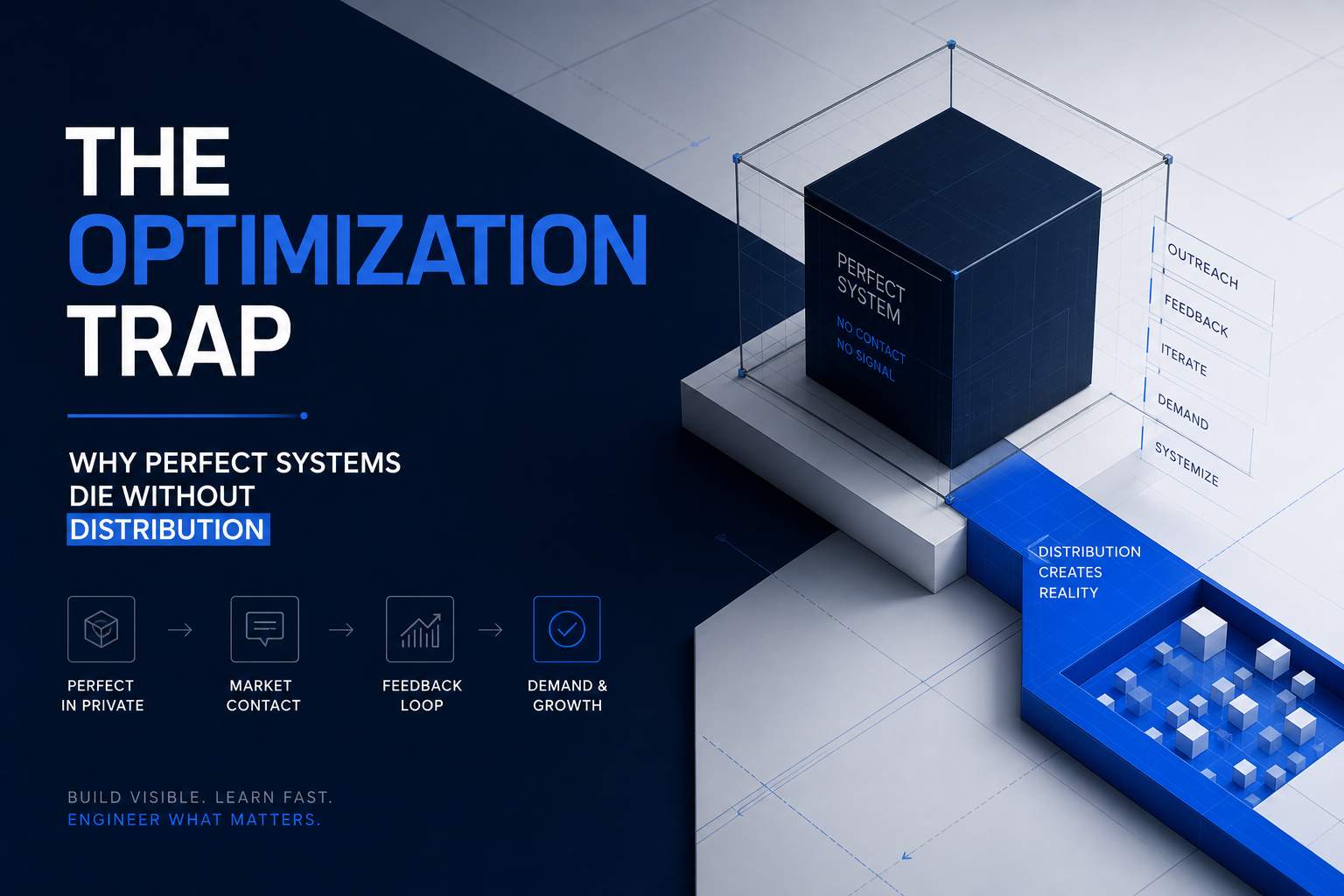
The best product in the room can still lose.
Not because the engineering is weak. Not because the interface lacks polish. Not because the AI model is wrong. It loses because nobody sees it, nobody tests it, nobody reacts to it, and nobody pays for it.
That is the quiet failure pattern inside many technical teams.
They do not fail by being lazy. They fail by becoming too sophisticated too early.
A founder sees a simple opportunity: AI videos for local businesses, a lightweight automation for a manual workflow, a content engine for a niche market, a small internal tool for an operator drowning in spreadsheets. The idea has enough signal to test. The buyer exists. The workflow hurts. The output could be useful.
Then the system-builder enters the room.
The question changes from “Who will buy this?” to “Which tool gives the cleanest output?” Then to “How do we reduce cost per render?” Then to “Can we automate the whole pipeline?” Then to “Should we build a reusable dashboard?” Then to “How do we make the prompt system modular?” Then to “What if the quality is not good enough?”
The business has not spoken to ten buyers yet.
This is not discipline. It is avoidance disguised as engineering.
Key Highlights
- Internal perfection does not equal market value. Clients do not buy your private definition of quality. They buy outcomes they can recognize, use, and justify.
- Early optimization can become a bottleneck. Cost control, tooling research, automation, and quality gates create value only after the offer has evidence.
- Distribution is not a marketing layer. It is part of the operating system. Without outreach, the product has no feedback loop.
- The first objective is not scale. The first objective is external contact: proof that someone wants the outcome enough to respond, pay, refer, or complain.
- Execution beats hidden capability. A visible average offer can collect data. An invisible excellent system cannot.
The Real Bottleneck Is Not Production
The obvious conversation sounds tactical.
Which AI video tool should we use? Which model gives better motion? Which provider blocks fewer prompts? Which workflow makes the reel faster? Which subscription gives the best credit economics? Which prompt template produces the cleanest result?
Those questions matter later.
At the beginning, they often hide the real issue: the team has no market contact.
No outreach. No buyer conversations. No feedback. No pricing evidence. No distribution surface. No repeatable sales motion.
When that is the state of the business, production quality becomes a false battlefield. The team argues about tools because tools feel safer than rejection.
Tools give immediate feedback. Buyers give uncomfortable feedback.
A render fails and you can blame the model. A prompt fails and you can revise the syntax. A workflow fails and you can adjust the pipeline.
A buyer ignores you and the system has to confront a deeper question: does this offer matter?
That is why technical teams often overbuild before they sell. They prefer deterministic problems. They trust systems more than markets. They assume better production will create confidence, and confidence will create outreach.
The sequence is backwards.
Outreach creates information. Information tells you what to build. Building creates proof. Proof improves outreach. That loop creates the business.
Without the loop, the team optimizes in isolation.
The Founder-Engineer Trap
Founder-engineers carry a useful instinct: they hate waste.
They want clean systems, controlled costs, efficient workflows, reusable components, stable delivery, and high quality. Those instincts build serious companies when demand already exists.
Before demand exists, the same instincts can turn into a constraint cage.
The team wants the output to be cheap, fast, excellent, and operationally clean from day one. That combination sounds responsible. In practice, it asks a young business to behave like a mature production line before it has customers.
A mature operation can optimize across multiple variables because it has volume, templates, capital, data, trained operators, and known buyer expectations.
An early operation has none of that.
It has assumptions.
That means the first system should not maximize elegance. It should maximize learning.
The Early-Stage Constraint Stack
Most young offers break because they try to satisfy every constraint at once:
- Low cost: Spend almost nothing on tools, ads, labor, or experiments.
- High quality: Match premium references before anyone has paid.
- High speed: Deliver quickly without a mature workflow.
- High customization: Adapt to every buyer before the buyer pattern is known.
- Low risk: Avoid rejection, avoid public testing, avoid visible imperfection.
- High confidence: Wait until the offer feels safe enough to show.
This is an engineering nightmare because the constraints fight each other.
If you want low cost and high quality, speed drops. If you want speed and customization, quality control drops. If you want low risk and high confidence, distribution drops. If distribution drops, learning stops. If learning stops, the system optimizes around fantasy.
The correct first constraint is simpler:
Build something visible enough to start the next conversation.
Not perfect. Not scalable. Not fully automated. Not architecturally beautiful. Visible enough.
Perfect for Whom?
The most dangerous sentence in early product work is: “It is not good enough yet.”
Sometimes that sentence protects standards. Often it protects ego.
The question is not whether the output meets your internal standard. The question is whether the buyer recognizes value.
A restaurant owner might not care whether the AI food reel has perfect physical continuity. They may care that the post makes the dish look exciting enough to publish today.
A singer might not care whether every frame matches cinematic grammar. They may care that the teaser makes the track feel bigger.
A local gym might not care whether the motion system has occasional artifacts. They may care that the reel gives them a campaign angle for the weekend.
A founder might not care whether the internal tool uses the most elegant architecture. They may care that it removes a daily spreadsheet task and stops errors.
Quality matters. But quality must be defined against the buyer’s operating reality, not the builder’s private taste.
Technical quality answers: “Is this built well?” Market quality answers: “Does this create value now?”
Tasawom’s work lives at the intersection. We do not treat production quality as decoration. We treat it as a business instrument. But the instrument must point toward a real operational outcome.
A clean system that nobody uses is not quality. It is unused complexity.
Distribution Is a System, Not a Mood
Many teams treat distribution as a personality trait.
They think outreach belongs to extroverts, marketers, influencers, or people with natural social confidence. That framing creates paralysis. It turns market contact into a character judgment instead of an operational process.
Distribution is not a mood. It is a system.
A simple distribution system has five parts:
- A defined buyer: Who feels the pain?
- A visible artifact: What can they understand in seconds?
- A specific offer: What outcome can they buy?
- A contact rhythm: How many conversations happen every week?
- A feedback record: What patterns appear in replies, objections, silence, and payment?
Without those parts, the business runs blind.
The founder keeps improving the product, but the product receives no pressure from reality. The team adds features, upgrades tools, rewrites pages, changes prompts, and debates pricing. None of it compounds because none of it connects to market response.
A distribution system does not need to be elegant at first. It needs to run.
Thirty direct messages can teach more than thirty hours of tool comparison. Ten sample assets can teach more than ten internal strategy calls. One paid pilot can expose more truth than a complete brand deck.
The goal is not to become loud. The goal is to create contact.
The Production-Distribution Loop
A useful business does not separate production from distribution. It connects them through a repeatable loop.
1. Build a small proof artifact
Create something a buyer can judge quickly: a sample reel, a before-and-after automation, a clickable prototype, a process dashboard, a short case demo, or a one-page offer.
The artifact should answer one question:
“Can the buyer imagine this inside their own business?”
2. Put it in front of specific buyers
Do not publish and hope. Send it to people with a reason to care.
A barber needs more bookings. A gym needs visual proof of energy. A restaurant needs posts that make products easier to sell. A clinic needs fewer manual follow-ups. A distributor needs cleaner order handling. A service business needs faster lead qualification.
Specificity makes outreach feel less like spam and more like diagnosis.
3. Record the response
Silence is data. Confusion is data. A price objection is data. A referral is data. A request for a different format is data. A fast “yes” is data.
Do not emotionally interpret every reply. Operationalize it.
Create a simple table:
- Buyer type
- Offer sent
- Asset shown
- Response
- Objection
- Follow-up required
- Price sensitivity
- Next action
This turns outreach into telemetry.
4. Improve the offer before the tooling
Most teams do this backwards. They improve the pipeline before they improve the offer.
But the buyer might not need better rendering. They might need a clearer package, faster delivery, a safer guarantee, better examples, simpler pricing, or a different use case.
Tooling should follow evidence.
5. Systemize only what repeats
Automation without repetition creates waste.
If five buyers ask for the same format, template it. If three buyers use the same objection, answer it in the page. If a workflow repeats ten times, automate it. If a step creates avoidable errors, build guardrails. If a delivery stage blocks speed, standardize it.
This is how production-grade systems emerge from real demand instead of abstract planning.
Why Mediocre Public Work Often Wins
This point irritates technical people, but it matters.
A mediocre offer in public can outperform a stronger offer in private.
Not forever. Not in sophisticated markets. But early, visibility gives mediocre work a learning advantage.
The public offer collects comments, objections, referrals, buyer language, use cases, and pricing signals. The hidden offer collects internal opinions.
That is why someone can create a rough AI video tutorial, publish it, attract attention, and start conversations while a more capable team spends a week comparing providers.
The first person has a weaker production system but a stronger feedback loop.
The second team has stronger taste but no contact surface.
Markets reward contact before they reward refinement.
This does not mean quality is irrelevant. It means quality needs direction. Market contact supplies that direction.
The Cost of Contempt
There is another hidden leak in the system: uncontrolled harshness.
Blunt diagnosis can save time. It cuts through fantasy. It forces decisions. It names the bottleneck.
But contempt damages the network that distribution depends on.
A friend who asks a naive question might become an operator, referrer, client scout, content partner, or early tester. If the conversation turns into humiliation, the network weakens. The team loses social surface area.
The better move is not politeness for its own sake. The better move is operational precision.
Instead of saying, “That is stupid,” say:
“The video is not the hard part. Selling ten imperfect versions is the hard part. Let’s test demand before we obsess over tools.”
Same truth. Lower damage. Higher probability of action.
A serious business protects its channels. People are channels. Conversations are channels. Trust is infrastructure.
The 20/80 Rule for Early Offers
When an offer has no proof, no buyer list, and no payment history, use a hard operating rule:
Spend 20% of effort on production optimization. Spend 80% on distribution contact.
That ratio feels uncomfortable for technical teams. It should.
The discomfort reveals the dependency.
Production work feels controllable. Outreach feels exposed. Production gives visible progress. Outreach gives uncertain feedback. Production protects identity. Outreach tests it.
But the business does not need emotional comfort. It needs signal.
What 20% Production Looks Like
- Build 5–10 sample assets.
- Use one or two tools, not ten.
- Pick a fixed output format.
- Limit revisions.
- Define delivery time.
- Create one simple pricing ladder.
- Prepare a short explanation of the result.
What 80% Distribution Looks Like
- Send 30–50 relevant messages.
- Ask for referrals.
- Post samples publicly.
- Test two buyer segments.
- Track every response.
- Follow up once.
- Record objections.
- Convert interest into paid pilots.
This is not glamorous. It is useful.
Service-Ready Takeaways
1. Define the buyer before the workflow
Do not start with the model, prompt, framework, dashboard, or architecture.
Start with the buyer’s active pain.
Ask:
- Who loses time, money, attention, or credibility because this problem exists?
- What output would they recognize as useful?
- What would make them reply today?
- What can they approve without a long procurement process?
The workflow should serve that answer.
2. Build proof that creates a conversation
A proof artifact does not need to explain the whole system. It needs to make the buyer say one of three things:
- “Can you do this for us?”
- “How much does it cost?”
- “Can it work for this use case instead?”
Those replies give the system direction.
3. Price the first version as a test, not a brand statement
Early pricing should reduce friction and expose willingness to pay. It should not attempt to prove prestige.
Use simple packages. Limit scope. Deliver fast. Learn where the buyer sees value.
Then raise prices around repeatable demand, not imagined positioning.
4. Turn outreach into telemetry
Do not measure only likes, views, or vague interest.
Measure:
- response rate
- qualified replies
- buyer segment
- objection type
- requested use case
- conversion to call
- conversion to payment
- repeat request
This converts distribution from emotional labor into an operating dashboard.
5. Automate after repetition
Do not build a large internal system for an offer nobody has bought.
Run manually first. Identify repetition. Standardize the repeated step. Add automation only when it reduces proven friction.
That is how you avoid building beautiful machinery for a market that does not exist.
The Tasawom Approach
Tasawom does not treat digital execution as a performance of activity.
We architect systems around business movement: clearer operations, faster delivery, cleaner workflows, measurable outcomes, and production-grade reliability.
That means we do not begin by asking, “What can we build?”
We ask:
- What bottleneck blocks the business?
- Which output would create immediate leverage?
- Which workflow repeats enough to justify systemization?
- Which human process creates errors, delays, or hidden cost?
- Which proof artifact can validate demand before deeper engineering?
This is the difference between building software and building operating capacity.
A weak agency sells assets. A shallow consultancy sells theory. A tactical dev shop sells tickets.
A serious engineering partner designs the loop: signal, workflow, system, delivery, evidence.
That loop matters more than any single AI tool, dashboard, landing page, or automation script.
The Decision
Do not spend another week searching for the perfect production stack before the market has responded.
Create the minimum proof. Show it to real buyers. Record the reaction. Improve the offer. Then engineer the system around what repeats.
The next level of execution does not come from more private optimization. It comes from external pressure.
Perfect systems do not create demand by staying hidden.
Visible systems learn.
Reliable systems convert that learning into repeatable delivery.
Production-grade businesses do both.
Start a Strategic Conversation with Tasawom if your team needs to turn scattered ideas, manual workflows, or AI experiments into systems that move the business. Or Explore our Featured Projects to see how strategy becomes shipped infrastructure.
_Source note: This post was inspired by internal conversation notes about the risk of optimizing production before outreach, including the “no outreach → no market feedback” loop and the 20/80 production-distribution rule. *