How to Destroy a Working Business
A sharp operating analysis on how boundaries, roles, money, family dynamics, and missing performance metrics can collapse a business that already works.
A business does not collapse only because demand disappears.
Many working businesses collapse while customers still want the product, revenue still comes in, and the market still leaves room to grow.
The failure starts somewhere less visible: inside the operating system of the business.
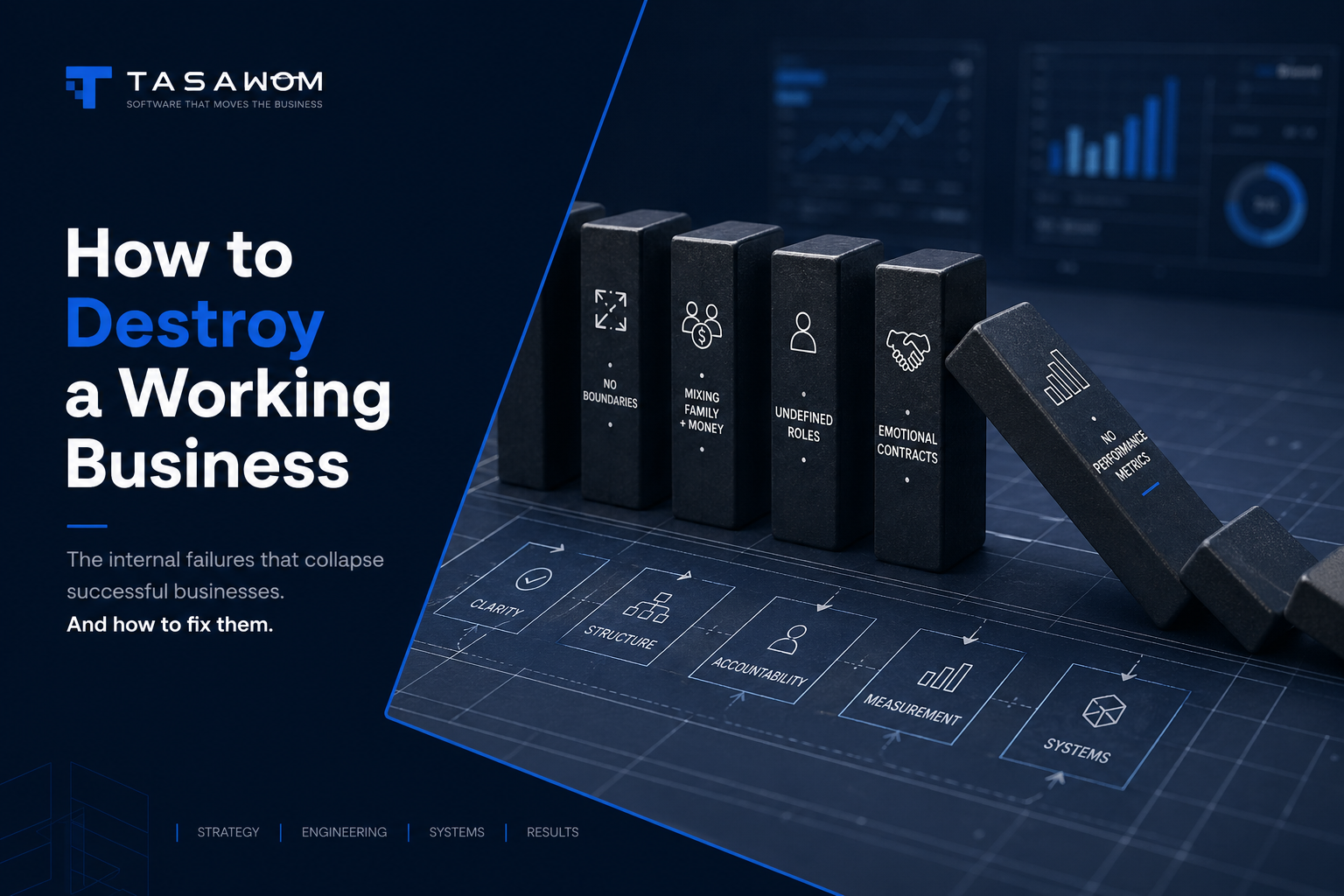
No boundaries. Family and money mixed without structure. Undefined roles. Emotional contracts. No performance metrics.
That combination can destroy a business that already works.
The dangerous part is that it rarely looks like mismanagement at first. It looks like loyalty. It looks like helping. It looks like “we are family.” It looks like flexibility. It looks like keeping things human.
Then the business starts paying for ambiguity.
One person thinks they are helping. Another thinks they are working. One person thinks money represents compensation. Another thinks it represents care. One person expects performance. Another expects patience. Everyone uses the same words, but no one means the same thing.
That is how a functioning business becomes a conflict machine.
Tasawom sees this pattern often in growing businesses, family operations, service teams, and founder-led companies. The issue usually does not start with a lack of effort. It starts with an absence of architecture.
When the business depends on memory, emotion, verbal agreements, and personal interpretation, it cannot scale. It can only survive until pressure exposes the missing system.
Key Highlights
- A working business can fail without a market problem. Internal ambiguity can create more damage than external competition.
- Family logic and business logic must not use the same operating rules. Care, support, ownership, compensation, and accountability need different structures.
- Undefined roles create emotional debt. People fight because expectations live in their heads, not inside a shared system.
- Metrics reduce conflict. Clear deliverables, schedules, standards, and payment rules move disagreement from personality to performance.
- Systems protect relationships. Structure does not make a business less human. It removes the avoidable friction that turns people against each other.
The Real Problem: The Business Works, But the System Does Not
A broken business announces itself. Sales drop. Customers leave. Cash runs out. The team sees the problem because the numbers make the failure visible.
A working business with a broken operating model looks more confusing.
The product sells. Customers return. People know the work. The opportunity exists. Yet the business cannot move cleanly. Every small decision becomes personal. Every missed task becomes a character judgment. Every payment becomes a negotiation. Every request carries emotional history.
The business has demand, but it lacks governance.
That is the strategic bottleneck.
Most small teams do not fail because they lack talent. They fail because they run talent through unclear agreements. They expect maturity to replace structure. They expect love, loyalty, or friendship to solve what only operational design can solve.
A food business can have a strong product and still fail because the roles remain unclear.
A consulting business can have strong demand and still fail because the founder keeps approving exceptions.
A software team can ship good work and still fail because no one owns scope, quality, or handoff.
A family business can earn money and still collapse because no one separates care from compensation.
The pattern stays the same: a real business runs on informal logic until the informal logic turns expensive.
How to Destroy a Working Business
You do not need a bad product to destroy a business.
You only need to build the company around invisible assumptions.
1. Remove Boundaries
Let everyone access everything.
Let personal emotions enter work decisions without limits. Let people discuss money during conflict. Let family hierarchy override business roles. Let work hours, expectations, availability, and authority remain undefined.
At first, this feels efficient. No paperwork. No process. No friction.
Then the business loses clean edges.
A boundary defines where one responsibility ends and another begins. Without it, every person starts carrying unclear obligations. Work becomes personal. Feedback becomes disrespect. Payment becomes affection. Help becomes entitlement.
In operational terms, the company loses containment.
A business without boundaries cannot tell the difference between a request, a responsibility, a favor, and a dependency. That confusion creates resentment because people keep paying invisible costs.
Pro-Tip: Do not use emotional closeness as an operating model. Use clear agreements, then let emotional closeness exist safely around them.
2. Mix Family and Money Without a System
Family relationships carry memory. Business relationships require measurement.
When money moves inside a family business without written rules, it changes shape depending on who looks at it.
To the parent, the payment may represent support. To the sibling, it may represent wages. To the founder, it may represent cost. To the team, it may represent unfairness. To the business, it represents cash flow.
One transaction can carry five meanings.
That is dangerous.
When compensation lacks criteria, money stops being a management tool and becomes emotional ammunition. People do not ask, “What output did this payment buy?” They ask, “What does this payment say about my value?”
That question can destabilize the whole operation.
A business needs a compensation model that separates four categories:
- Salary or wage: payment for defined work.
- Bonus: reward for measured performance.
- Loan: temporary financial support with repayment terms.
- Gift: personal support that does not create work expectations.
Mix these categories and you create a contract no one can enforce.
The damage compounds. The person receiving money may lower effort because the payment feels guaranteed. The person giving money may increase expectations because the payment feels generous. Both sides feel justified. Both sides feel wronged. The business absorbs the cost.
3. Keep Roles Undefined
Undefined roles do not create flexibility. They create jurisdiction fights.
When no one defines who owns what, every task becomes a negotiation. Every mistake becomes a search for blame. Every improvement becomes optional because no one holds the authority to enforce it.
A role needs four parts:
- Ownership: What does this person control?
- Output: What must this person produce?
- Decision rights: What can this person decide without approval?
- Accountability: What happens when standards slip?
Without these four parts, people rely on personality. The assertive person takes power. The passive person retreats. The frustrated person explodes. The responsible person overfunctions. The business starts depending on moods instead of management.
This is where many family businesses break.
A son is both employee and child. A mother is both owner and parent. A sibling is both partner and dependent. A spouse is both advisor and emotional stakeholder.
Those identities can coexist only when the business identity has its own structure.
Inside work, the role must lead. Outside work, the relationship can breathe.
Without that separation, the business turns every operational issue into a family tribunal.
4. Build Emotional Contracts Instead of Written Agreements
An emotional contract sounds like this:
“After everything I did for you, you should help.” “I thought you understood.” “You know what I meant.” “I should not have to explain this.” “We are family.” “You are acting like I am just an employee.” “You are treating me like this is only business.”
These statements reveal a missing agreement.
People use emotional contracts when they expect performance without defining performance. They assume shared history creates shared standards. It does not.
A written agreement does not remove trust. It protects trust from misinterpretation.
The strongest teams write things down because memory changes under pressure. People remember conversations through their own needs, fears, and incentives. A written agreement gives the business a stable reference point.
That agreement does not need legal complexity. It needs operational clarity.
For example:
- Work schedule.
- Scope of responsibility.
- Payment terms.
- Quality standards.
- Escalation path.
- Review cadence.
- Exit terms.
These elements turn emotional interpretation into operational visibility.
5. Avoid Performance Metrics
Nothing creates conflict faster than unclear performance.
When a business has no metrics, people evaluate each other through attitude. The conversation shifts from “Did the work meet the standard?” to “You are lazy,” “You are controlling,” “You do not respect me,” or “You never appreciate anything.”
Metrics prevent that drift.
A metric gives the team something external to look at. It creates a shared surface. It allows people to discuss reality without making each other the battlefield.
Performance metrics do not need to be complex. They need to be visible, relevant, and connected to value.
For a food operation, metrics may include:
- Orders completed per day.
- Waste percentage.
- Delivery accuracy.
- Customer complaints.
- Production time per batch.
- Margin per product.
- Repeat orders.
For a service team, metrics may include:
- Response time.
- Delivery time.
- Revision count.
- Client satisfaction.
- Project margin.
- Scope change frequency.
- On-time handoff rate.
For a software team, metrics may include:
- Cycle time.
- Defect rate.
- Uptime.
- Deployment frequency.
- Support tickets.
- Feature adoption.
- Task completion reliability.
The metric does not replace judgment. It gives judgment a frame.
Why Traditional Advice Fails
Most people respond to this kind of business conflict with soft advice.
“Communicate better.” “Be patient.” “Respect each other.” “Separate emotions.” “Try to understand both sides.”
This advice sounds mature, but it fails because it treats an operating problem like a personality problem.
Communication improves nothing when the underlying agreement remains unclear.
Patience delays the explosion but does not remove the trigger.
Respect helps the tone but does not define ownership.
Understanding both sides may reduce heat, but it cannot calculate compensation, define quality standards, or decide who owns the customer relationship.
A business needs structure before harmony.
The deeper issue is not that people refuse to communicate. The deeper issue is that communication has nowhere to land. There is no system to receive it, convert it into decisions, and enforce it consistently.
That is why the same arguments repeat.
The team discusses the issue, calms down, returns to work, then hits the same ambiguity again. The conflict cycles because the business changes nothing in its operating design.
In systems language, the business keeps processing new tension through the same broken loop.
A stronger business changes the loop.
The Tasawom Solution: Turn Relationship Chaos Into Operating Architecture
Tasawom approaches this problem like a systems operator, not a motivational advisor.
The goal is not to make everyone feel aligned for one meeting. The goal is to design an operating model that keeps the business clear when pressure returns.
That means we convert invisible expectations into visible architecture.
1. Map the Actual Workflow
Most businesses think they understand how work happens. They usually understand how work should happen.
The difference matters.
We map the real flow:
- Where does demand enter?
- Who receives the request?
- Who decides priority?
- Who performs the work?
- Who checks quality?
- Who handles money?
- Who communicates with the customer?
- Where do delays happen?
- Where do arguments repeat?
This exposes the real system. Not the declared system. The operating system.
Once the workflow becomes visible, the team can stop arguing about personalities and start fixing handoffs, approvals, incentives, and decision rights.
2. Separate Relationship Roles From Business Roles
We do not ask family members to stop being family.
We ask the business to stop relying on family logic for operational decisions.
A healthy structure distinguishes:
- Ownership role.
- Management role.
- Employee role.
- Support role.
- Investor role.
- Family role.
One person may hold more than one role, but the business must know which role speaks in each context.
A parent can care personally and still manage compensation objectively. A sibling can receive support and still meet work standards. A founder can protect relationships and still enforce delivery rules.
The separation creates maturity. It does not create distance.
3. Define the Operating Contract
Every role needs a simple operating contract.
This contract answers:
- What do you own?
- What do you deliver?
- How do we measure delivery?
- When do we review performance?
- How do we pay?
- What happens when expectations change?
- How do we exit cleanly if the role no longer works?
This reduces drama because the business no longer needs to renegotiate reality during every conflict.
4. Install Metrics That Match the Business Model
Metrics should not become theater.
A business does not need a dashboard full of noise. It needs a small set of numbers that reveal whether the system works.
We usually start with three layers:
- Output metrics: What did the person or team produce?
- Quality metrics: Did the output meet the required standard?
- Business metrics: Did the work improve revenue, margin, retention, speed, or reliability?
This creates a clean line between effort and value.
People can still discuss context. They can still discuss constraints. But the conversation starts from shared evidence.
5. Build a Review Rhythm
No system stays clean without a cadence.
A review rhythm prevents buried resentment. It creates a scheduled place for feedback, adjustment, and accountability.
A simple operating rhythm may include:
- Weekly work review.
- Monthly financial review.
- Quarterly role review.
- Exception log for unclear cases.
- Decision record for important changes.
The goal is not bureaucracy. The goal is memory.
A business that records decisions does not need to relitigate them every week.
The System Replacement: From Human Friction to Clean Operations
A working business becomes scalable when it stops depending on heroic emotional labor.
The owner should not need to become a house tyrant to restore order. The responsible person should not need to mediate every fight. The team should not need to guess what money means. The family should not need to sacrifice the relationship every time the business needs accountability.
The system should carry that weight.
Good operations create a neutral layer between people. That layer includes roles, workflows, metrics, agreements, dashboards, review rhythms, and decision rules.
This is where software becomes useful.
Not because software magically fixes family conflict, but because software forces clarity.
A production-grade internal system can:
- Track orders.
- Assign responsibilities.
- Record payments.
- Measure output.
- Monitor delivery.
- Store customer data.
- Show margins.
- Flag delays.
- Standardize approvals.
- Reduce verbal dependency.
When the process lives only in people’s heads, the business stays fragile. When the process lives inside a shared system, the business can grow without turning every decision into a personal negotiation.
That is the core Tasawom lens: replace messy human processes with clean, reliable systems.
Practical Takeaways: Fix the Business Before It Breaks
Here are five service-ready actions any founder, operator, or family business can implement immediately.
1. Create a Role Map
List every person involved in the business. For each person, define:
- Their business role.
- Their responsibilities.
- Their decision rights.
- Their reporting line.
- Their compensation type.
Do not accept “helps with everything” as a role. That phrase hides risk.
2. Separate Money Categories
Create separate labels for wage, bonus, loan, gift, owner distribution, and reimbursement.
Never let one payment mean two things.
When you support someone personally, name it as support. When you pay for work, define the work. When you reward performance, define the metric.
3. Define the Minimum Performance Standard
For every role, define the minimum acceptable output.
Example:
- Number of shifts per week.
- Number of orders completed.
- Delivery deadlines.
- Quality checks.
- Customer response time.
- Error tolerance.
- Escalation rules.
This standard protects the business from emotional interpretation.
4. Write the Operating Agreement in Plain Language
Do not wait for a lawyer to create operational clarity.
Write a one-page agreement that covers work, payment, schedule, standards, review, and exit. Keep it practical. Review it together. Update it when reality changes.
The document does not need to sound formal. It needs to remove ambiguity.
5. Move the Workflow Into a System
Use a lightweight tool first if needed: a shared spreadsheet, task board, CRM, order tracker, or internal dashboard.
The key principle: work should not depend on verbal memory.
When the business grows, replace the temporary tool with a proper internal system that matches the workflow.
The Real Lesson
A working business deserves protection from its own informality.
Many operators wait until conflict becomes unbearable before they introduce structure. That delay costs money, time, trust, and momentum.
Structure should not arrive as punishment after failure. It should arrive as infrastructure before scale.
Boundaries protect focus. Defined roles protect accountability. Clear compensation protects trust. Metrics protect fairness. Systems protect the business from avoidable chaos.
A business does not need to become cold to become professional.
It needs to become legible.
When everyone can see the work, understand the rules, measure the output, and separate personal care from business accountability, the company stops burning energy on interpretation. It starts using that energy to serve customers, improve margins, and scale operations.
That is how you stop destroying a working business.
You give it an operating system.
Start a Strategic Conversation
If your business works but still feels heavy, slow, or conflict-driven, the problem may not be the product. It may be the system underneath it.
Tasawom helps teams architect web platforms, AI tools, and internal systems that reduce manual work, clarify operations, and turn business complexity into reliable execution.
Start a Strategic Conversation with Tasawom to turn fragmented workflows into production-grade systems—or Explore our Featured Projects to see how execution-layer engineering moves from strategy to shipped software.