Fast AI-Resistant Online Income in 2026: Where Human Judgment Still Wins
A practical guide to online income paths that still depend on trust, judgment, live communication, and real execution in an AI-heavy market.
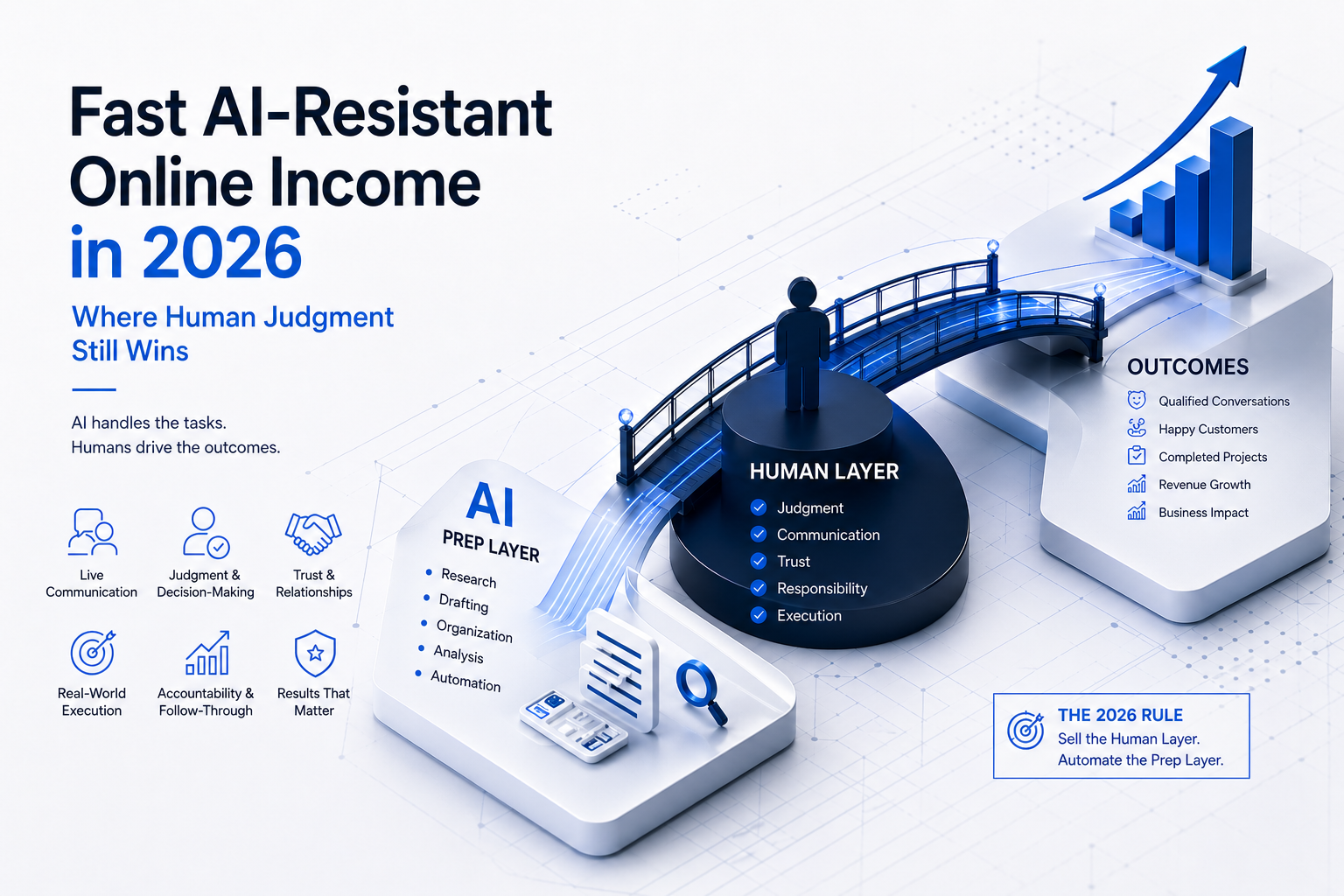
Fast AI-Resistant Online Income in 2026: Where Human Judgment Still Wins
AI did not kill online income.
It killed lazy online income.
That distinction matters.
In 2026, the market has very little patience for generic digital work. Basic writing, simple design, data entry, low-context support, and undifferentiated virtual assistance now compete against tools that produce acceptable first drafts in seconds.
So the question is no longer: “What online job can I do fast?”
The better question is: “Where does a buyer still need human trust before they pay?”
That is where the real opportunity sits.
The fastest AI-resistant income paths are not passive. They are not magic side hustles. They are service systems where AI can accelerate the work, but a human still owns the result: qualification, explanation, accountability, judgment, relationship handling, and real-world follow-through.
This post is built from the provided research base and rewritten to match Tasawom’s operating voice: outcome-first, direct, technical, and anti-fluff.
Key Highlights
- Do not compete with AI on raw output. Compete where judgment changes the business result.
- Avoid commodity work. Generic writing, data entry, basic admin, and simple support face heavy pricing pressure.
- Sell trust-heavy services. Appointment setting, tutoring, recruiting sourcing, customer onboarding, community management, no-code implementation, and resale remain stronger bets.
- Use AI as infrastructure. Let it research, summarize, draft, organize, and document. Keep the human layer responsible for decisions and delivery.
- Start with one narrow offer. Fast income comes from clear positioning, not from chasing ten unrelated gigs.
The Strategic Bottleneck: Output Is Cheap Now
For years, online income advice rewarded production.
Write more articles. Design more graphics. Complete more tasks. Send more applications. Offer more services.
That model breaks when production becomes abundant.
AI changed the supply curve. Clients can now generate acceptable drafts, layouts, scripts, emails, summaries, and support responses with minimal effort. That does not make people useless. It makes generic output less valuable.
The work that still holds value has a different shape.
It includes:
- handling uncertainty
- building trust
- qualifying real buyers
- teaching with patience
- managing sensitive conversations
- coordinating messy operations
- implementing tools correctly
- taking responsibility when the system fails
That is the human layer.
And in 2026, the human layer is where pricing power still exists.
Pro-Tip: If the task can be judged by volume alone, AI will compress the price. If the task depends on trust, risk, timing, or accountability, a human operator can still charge.
The Rule: Automate Preparation, Sell Responsibility
The durable strategy is simple.
Use AI below the surface. Do not make AI the offer.
AI can help you research prospects, draft outreach, summarize candidate profiles, prepare lesson plans, create onboarding checklists, analyze community themes, and structure website copy.
But the buyer does not pay for your prompt.
The buyer pays for the business result.
A qualified meeting. A student who improves. A shortlist of relevant candidates. A customer who activates. A community that does not collapse into noise. A booking funnel that actually works. A financial cleanup that reduces confusion.
That is the difference between using AI as a gimmick and using AI as an operating layer.
1. Appointment Setting and Lead Qualification
Appointment setting remains one of the fastest ways to earn online because businesses still need conversations with qualified buyers.
But the work is not “sending messages.” That layer is already being automated.
The valuable work is knowing who to contact, how to personalize the approach, how to qualify interest, how to handle early objections, and how to move serious prospects into booked calls.
Why It Still Works
A bad appointment setter fills the calendar.
A good appointment setter protects the calendar.
That difference matters. A founder does not need ten weak calls. They need three serious conversations with buyers who understand the offer and have a real reason to speak.
AI can help build lists and draft first messages. It cannot fully manage trust, timing, context, objection handling, and follow-up quality.
Best Fit
This path fits people who can handle rejection, repetition, and direct communication.
You need:
- clear writing
- basic sales logic
- follow-up discipline
- comfort with outreach
- simple CRM hygiene
- enough confidence to qualify people
Fast Start
Pick one niche. Do not sell to everyone.
Good starting niches include clinics, agencies, SaaS teams, recruiters, real estate operators, legal firms, and premium local services.
Build one narrow offer:
“I help [niche] book qualified calls with [buyer type] without wasting founder time.”
Then send 100 to 200 targeted messages. Keep the scope small. Sell a one-week paid pilot. Measure replies, booked calls, and show rate.
Risk
Do not become a cheap list-builder.
List-building is exposed. Qualification and booked conversations are stronger. Price around outcomes, not activity.
2. Online Tutoring and Language Coaching
Tutoring survives because learning is not just information transfer.
AI can explain a concept. It can generate exercises. It can correct grammar. But it does not fully replace patience, accountability, confidence-building, live correction, and emotional calibration.
A student often knows what they need to learn. They still need someone to help them stay with it.
Why It Still Works
People pay tutors for progress, not information.
A strong tutor sees where the learner is stuck, adjusts the explanation, pushes at the right moment, slows down when needed, and creates a structure the student can follow.
That is hard to automate cleanly.
Best Fit
This path fits people who can teach a specific skill.
Strong examples:
- business English
- Arabic conversation
- IELTS speaking
- school mathematics
- Excel for work
- beginner Python
- interview preparation
- presentation coaching
Fast Start
Choose one clear learner outcome.
Do not say, “I teach English.” Say, “I help Arabic-speaking professionals speak more clearly in client meetings.”
That level of specificity improves conversion.
Create a strong profile, record a direct intro video, start with a competitive rate, and turn every first lesson into a structured continuation plan.
Risk
The main risk is poor retention.
Single lessons produce unstable income. Learning paths create recurring revenue. Give homework, track progress, and make the next step obvious.
3. Recruiting Sourcing and Candidate Outreach
Recruiting is expensive because hiring mistakes are expensive.
That is why candidate sourcing remains a practical online service. Companies do not only need names. They need relevant people, organized notes, fit logic, outreach status, and early signal.
Why It Still Works
AI can search faster. It can summarize profiles. It can draft outreach.
But recruiting still depends on judgment.
A good sourcer understands whether a candidate actually fits the role, whether the background makes sense, whether the market is realistic, and whether the outreach angle will land.
Best Fit
This path fits strong researchers.
You need:
- structured search habits
- concise writing
- attention to detail
- basic role understanding
- organized handoff notes
Fast Start
Do not sell full-cycle recruiting at the beginning.
Sell sourcing-only.
A clean offer looks like this:
“I deliver 10–20 qualified candidates for one role in 7–10 business days, with profile links, fit notes, and outreach status.”
Start with one role family: sales, customer success, executive assistants, analysts, SDRs, or support roles.
Risk
Do not promise a hire.
Promise a shortlist. Promise sourcing. Promise outreach support. Keep the scope under control.
4. Customer Onboarding and Customer Success Support
Customer success is not the same as answering tickets.
Support reacts. Customer success guides.
In 2026, AI can answer repetitive questions. But companies still need humans to help customers activate, understand value, complete setup, and stay engaged.
Why It Still Works
Many businesses lose customers after the sale because onboarding is weak.
The customer buys, then gets confused. They miss setup steps. They do not understand the product. They forget the next action. They stop using the service.
That is revenue leakage.
A customer onboarding operator reduces that leakage.
Best Fit
This path fits people who are calm, organized, and good at explaining.
You need:
- empathy
- process clarity
- follow-up discipline
- documentation habits
- comfort with customer calls
Fast Start
Target SaaS companies, agencies, course businesses, coaching programs, and recurring service firms.
Offer a two-week onboarding cleanup sprint.
Deliver:
- a new-customer checklist
- a follow-up sequence
- an activation tracker
- an escalation process
- a short improvement report
Risk
Avoid becoming a general support worker.
Position around activation, onboarding, retention, and process cleanup. Define response windows and escalation rules from the start.
5. Community Management and Moderation
Community management looks simple until people start behaving like people.
Members ask repeated questions. They complain. They compare results. They challenge rules. They disengage. They create noise.
A healthy community needs structure.
Why It Still Works
AI can draft posts and summarize discussions. It cannot fully own tone, conflict, escalation, context, and brand risk.
A good community manager protects the environment and extracts useful signals for the business.
They do not just “keep the group active.” They reduce chaos.
Best Fit
This path fits people who write clearly, stay calm, and can maintain a consistent operating rhythm.
Good markets include:
- course communities
- coaching groups
- SaaS user communities
- paid memberships
- creator communities
- founder groups
Fast Start
Offer a starter package:
- moderation
- welcome posts
- member questions routing
- weekly recap
- escalation log
- community health snapshot
Sell the business outcome: less founder time, better retention, cleaner feedback, and stronger member experience.
Risk
Availability can destroy the margin.
Set hours. Define channels. Separate moderation from customer support. Charge for responsibility, not constant presence.
6. No-Code Website and Booking-Funnel Implementation
AI website builders made it easier to create pages.
They did not solve implementation.
Most small businesses do not need another pretty template. They need a working path from visitor to lead, booking, or payment.
That includes positioning, page structure, forms, scheduling, analytics, mobile layout, and launch execution.
Why It Still Works
The value is not the page.
The value is the system behind the page.
A one-page site with a clear offer, booking flow, contact form, and analytics can create more business impact than a large redesign with no conversion logic.
Best Fit
This path fits builders who understand layout, tools, copy, and client communication.
You do not need to be a senior engineer to start. But you do need implementation discipline.
Fast Start
Pick one niche with weak websites.
Examples:
- medspas
- tutors
- clinics
- coaches
- contractors
- salons
- local service firms
Build one demo. Then sell a narrow package:
“One-page site + booking flow + contact form + analytics + launch checklist.”
Take a deposit. Limit revisions. Define the launch scope.
Risk
Scope creep is the main threat.
Do not sell “a full redesign” as your first offer. Sell a controlled implementation sprint.
7. Founder Operations and Project Coordination
Generic virtual assistance is weak.
Founder operations is stronger.
The difference is ownership.
A generic assistant waits for tasks. A founder-ops operator manages follow-up, project visibility, meeting notes, vendor coordination, hiring handoffs, SOP updates, and deadline control.
Why It Still Works
Small teams often do not fail because they lack ideas.
They fail because execution leaks.
Tasks disappear. Decisions stay in calls. Deadlines drift. Follow-ups die in inboxes. Nobody owns the operating rhythm.
That is a real business problem.
Best Fit
This path fits organized people who can communicate clearly and follow through without constant supervision.
Fast Start
Do not position yourself as a general VA.
Pick one operating outcome:
- weekly project reporting
- founder inbox triage
- hiring coordination
- client handoff management
- meeting notes and action tracking
- SOP cleanup
Create a weekly cadence and sell that cadence.
Risk
The risk is task dumping.
Protect the scope. Sell coordination and implementation support, not unlimited admin labor.
8. Bookkeeping Cleanup and Accounts-Receivable Follow-Up
Routine bookkeeping faces automation pressure.
But messy books still need human care.
Small businesses often need help organizing transactions, reconciling records, cleaning up categories, preparing summaries, and following up on unpaid invoices.
Why It Still Works
Financial records carry risk.
Errors create confusion, bad decisions, compliance problems, and cash-flow issues. AI can assist with categorization, but owners still want human oversight when records are messy.
Best Fit
This path fits detail-oriented people who like accuracy, spreadsheets, confidentiality, and repeatable processes.
Fast Start
Complete a quick bookkeeping or tool-specific training path.
Start with cleanup, not tax advice.
Offer a fixed deliverable:
“30-day bookkeeping cleanup + reconciliation summary.”
Ask for read-only access first. Document assumptions. Stay inside your competence.
Risk
Do not drift into regulated accounting or tax work unless qualified.
Stay with cleanup, reconciliation, records organization, and accounts-receivable support.
9. Online Resale and Consignment
Resale is AI-resistant for a simple reason: it touches the physical world.
AI cannot inspect your garage, grade condition perfectly, photograph the item honestly, package it, ship it, and handle disputes for you.
That physical friction creates opportunity.
Why It Still Works
Resale rewards judgment.
You need to know what has demand, what condition matters, how to price, how to photograph, how to write accurate listings, and how to ship without creating problems.
Best Fit
This path fits people who want fast cash and can manage logistics.
Fast Start
Start with items you already own:
- electronics
- books
- tools
- hobby gear
- accessories
- branded clothing
Check sold prices before listing. Use clear photos. Write honest condition notes. Avoid high-fraud categories early.
Risk
Bad pricing, returns, fraud, and shipping errors can erase profit.
Start small. Learn the platform. Then consider consignment.
10. Inbound Closing and DM-to-Call Conversion
Inbound closing is close to revenue.
Instead of cold outreach, you handle warm leads from DMs, WhatsApp, website forms, comments, or chat.
The person already showed interest. Your job is to guide them to the correct next step.
Why It Still Works
AI can draft replies. But buyers often need reassurance, clarity, urgency, and trust.
A good closer does not pressure people. They qualify, clarify, answer objections, and move serious buyers forward.
Best Fit
This path fits people with empathy, concise writing, and sales discipline.
Fast Start
Target businesses that already receive inbound interest.
Offer to manage one channel first:
- Instagram DMs
- website forms
- live chat
- comments
Track speed-to-response, calls booked, show rate, and closed revenue.
Risk
Commission disputes can happen.
Define what counts as a qualified call, a show, a sale, and an attributed lead before starting.
Comparative Snapshot
| Method | First-Money Window | AI Resistance | Startup Cost | Best For | |---|---:|---|---|---| | Appointment setting | 3–14 days | High | Very low | People comfortable with outreach | | Tutoring / coaching | 3–10 days | Very high | Very low | People who can teach clearly | | Recruiting sourcing | 7–21 days | High | Low | Strong researchers | | Customer onboarding | 1–3 weeks | High | Very low | Calm communicators | | Community management | 1–3 weeks | High | Very low | Moderators and writers | | No-code implementation | 5–21 days | Medium | Low | Builders with execution discipline | | Founder operations | 1–3 weeks | Medium | Very low | Organized operators | | Bookkeeping cleanup | 1–3 weeks | Medium | Low | Detail-oriented workers | | Resale / consignment | 1–7 days | Very high | Low to medium | People who can handle logistics | | Inbound closing | 1–3 weeks | High | Very low | People with sales judgment |
The 30/60/90-Day Execution Plan
First 30 Days: Choose One Offer
Do not start with five methods.
Pick one.
Then build the smallest credible version of the service:
- Appointment setting: one niche, one offer, 200 targeted messages.
- Tutoring: one learner outcome, one profile, one intro video.
- Recruiting: one role family, one sample shortlist.
- No-code: one niche demo, one fixed implementation package.
- Resale: 20 listings from items you already own.
The goal is not polish. The goal is market contact.
Days 31–60: Turn Work Into Proof
Once you get activity, measure it.
Track:
- replies
- bookings
- show rates
- student retention
- candidate quality
- onboarding completion
- community engagement
- site conversions
- revenue attributed
Proof gives you leverage. Without proof, you keep selling effort.
Days 61–90: Specialize
Generic providers compete on price.
Specialists compete on relevance.
Move from:
“I help with outreach.”
To:
“I book qualified calls for clinics selling high-ticket treatments.”
Move from:
“I build websites.”
To:
“I build one-page booking funnels for local service businesses.”
Specificity reduces friction because the buyer understands the value faster.
The Tasawom View: Build an Income System, Not a Gig List
The mistake is chasing methods.
The better move is to design a small operating system.
That system needs four parts:
- A clear buyer. Know who has the problem.
- A measurable outcome. Sell a result, not vague help.
- A repeatable acquisition channel. Use outreach, marketplace demand, referrals, or platform discovery.
- A delivery workflow. Use AI for research, drafts, summaries, checklists, and reporting.
This is how a beginner moves from random work to a real service.
AI should sit inside the workflow, not on the billboard.
The market does not need more people saying they “use AI.” It needs operators who can reduce chaos, ship outcomes, and own the result.
Service-Ready Takeaways
- Avoid work where output is the only value. Those categories face the fastest compression.
- Choose trust-heavy services. Sales, tutoring, recruiting, onboarding, communities, implementation, operations, and resale are stronger starting points.
- Narrow the buyer. A broad offer feels weak. A specific offer feels useful.
- Use AI to increase operating capacity. Research faster. Draft faster. Document faster. But keep judgment human.
- Track proof from day one. Metrics convert small projects into retainers.
Final Thought
Fast online income in 2026 belongs to people who can operate.
Not people who chase every trend.
Not people who sell generic output.
Not people who hope AI will do the whole job for them.
The opportunity sits in the middle: AI-powered preparation, human-owned delivery.
That is where trust still lives. That is where clients still pay.
If you want to turn a digital offer into a working system, start with one buyer, one outcome, and one repeatable delivery process.
Ready to build the system behind your next offer?
Start a Strategic Conversation with Tasawom to turn fragmented workflows into production-grade systems—or Explore our Featured Projects to see how execution-layer engineering moves from strategy to shipped software.